Simmons electronic drums and percussion
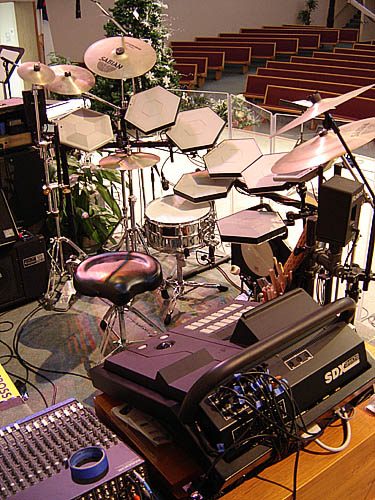
From 1984 to 1988 I was Technical Director of Simmons, building the engineering department for a new generation of processor-based electronic drums and percussion instruments.
I was a developer of the following products, with my contribution being:
SDS6
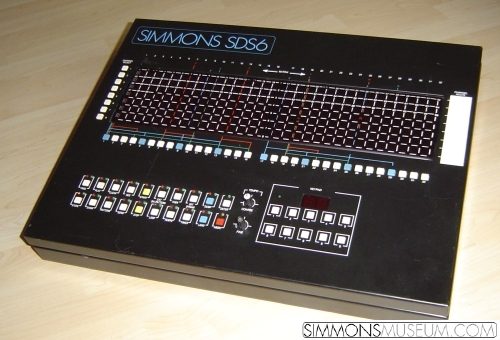
I started work on the SDS6 in 1981, before I joined Simmons. It was an eight-channel drum sequencer for driving Simmons drum modules. Each channel had a 32-step LED grid, songs could be built from up to 99 patterns, and a "Humaniser" added small random timing variations. It had trigger outputs, sync for external tape machines and a data interface.
My contribution: architecture, hardware, software.
SDS7
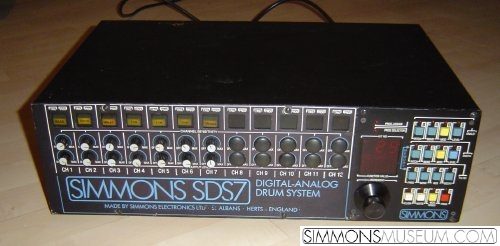
A modular rack drum system, launched in 1984, that combined analogue sound generation with sampled drum sounds. A rack held up to 12 modules and could store 100 kits.
My contribution: software.
SDS9
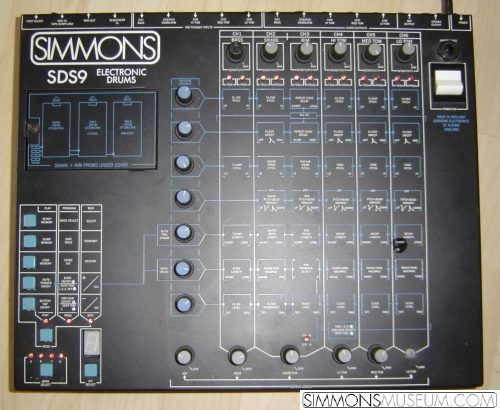
A five-piece electronic kit, launched in 1985, with a digital and analogue drum module, a sampled snare, built-in MIDI and 40 kit memories. It won Most Innovative Product, Drums/Percussion, at the NAMM 1986 Music & Sound Awards.
My contribution: digital hardware, software, and the bass drum software synthesizer.
SDS64
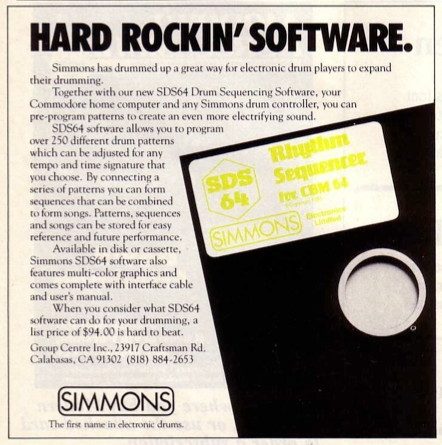
Drum sequencing software for the Commodore 64 home computer, which played Simmons drums through an interface cable. It could hold over 250 drum patterns, chained into sequences and songs, on disk or cassette.
My contribution: creator, software.
MTM
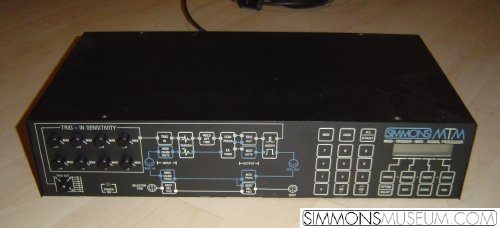
An eight-channel converter between drum triggers and MIDI, working in both directions, launched in 1986.
My contribution: design, architecture, software.
SDX
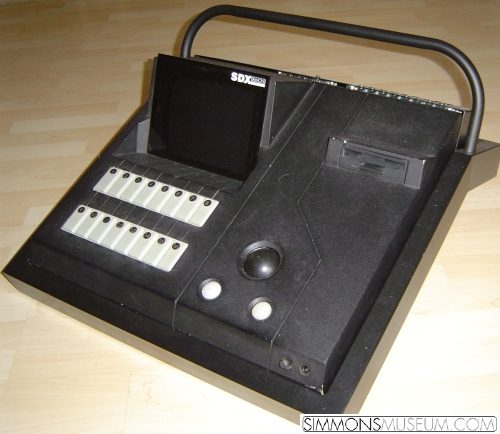
The 1987 flagship: a sampling drum system with a 16-bit sampler, a screen for editing, and "Zone Intelligence" pads that played different sounds depending on where they were struck.
Inside, it was a multiprocessor computer: one 32-bit, three 16-bit and two 8-bit processors, and two custom integrated circuits, running multitasking software with icons and pull-down menus in the style of the Apple Macintosh. It sampled at 16 bits, at 44.1, 22 or 11 kHz, and played 16 voices, each through an analogue VCA and filter to its own output, with a 16-into-2 stereo mix as well. Memory was 2 MB, expandable to 8 MB, enough for 88 seconds of sampling at 44.1 kHz. Sounds were stored on 3.5-inch floppy disks, with an optional 20 MB hard disk and a SCSI port. The console had a 9-inch high-resolution monitor, a trackball and 16 pads, with MIDI and SMPTE. Each Zone Intelligence pad sensed where it was hit as well as how hard, and could switch between up to nine samples.
My contribution: co-architect, software.
Silicon Mallet
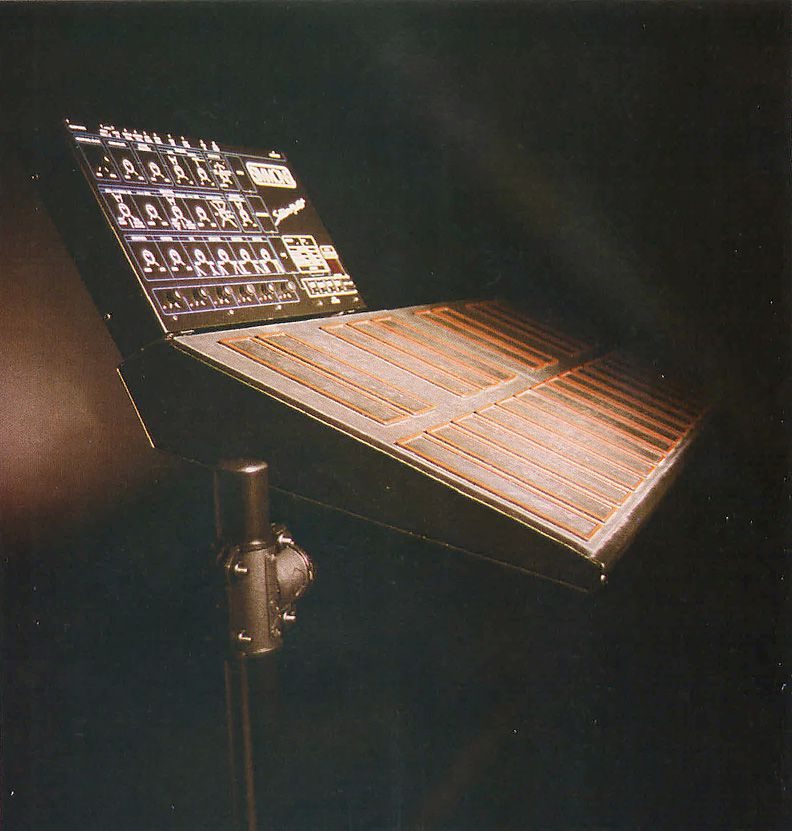
A three-octave, vibraphone-style MIDI mallet instrument.
My contribution: software.
Stepp guitar
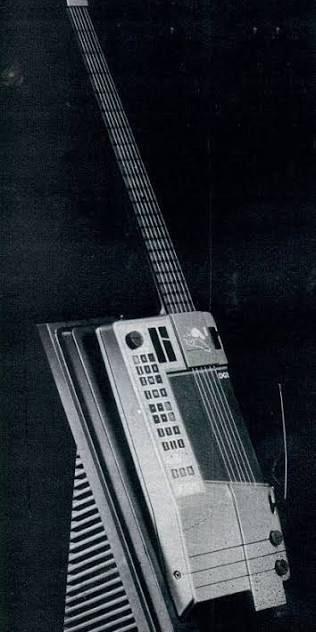
The Stepp guitar began as Stephen Randall's idea, which he brought to Dave Simmons, and early prototypes were built at Simmons. Simmons then decided to stay with drums, and Randall developed the design separately at Stepp Ltd as the DG1 guitar synthesizer, launched in 1986, and later the DGX MIDI controller.
My contribution: prototype software, derived from the SDS7 software.
Some of the product information and pictures on this page come from the Simmons Museum, with thanks.